Monday, 13 August 2012


Shades On – Part Deux

Following on from my previous moan regarding Dragonflies total lack of consideration, for the rank novice odonatologist (apologies if this is not the pukkah word), the little blighters have been testing me again this last week, but, thanks, to the aforementioned Guide, a tad of luck and a smidgeon of advice from the pros, this time I think I have them covered.

First up my mate the Ruddy Darter - he of the sexual gymnastics (not yet an Olympic sport). This chap posed superbly and I like to think this is one of my better dragon pics so far.


Having captured a good snap of the little red fellow, for reasons best known to myself, I decided to take some more pictures of another Ruddy Darter sitting on a fence rail. But – on checking the picture out, I noticed the yellow patches on the thorax and yellow leg stripes that indicated this is in fact a Common Darter (Sympetrum striolatum). Tick.


Now at this stage please forgive my slightly less than scientific approach, but I can’t help thinking that the head on view of many dragonflies look remarkably like a rather jolly US helicopter pilot, peering out of his bubble canopy. It’s not just me, is it?

I even managed to correctly identify with almost no outside help (thanks Tony F and Graeme) the very similar Southern Hawker and Migrant Hawker.

 Southern Hawker


Migrant Hawker

In order to keep a sense of perspective I have once again included a picture of one of the real pros when it comes to insect spotting. Long-tailed Tits have the saddest, pleading eyes, don’t you think?


Last week the FoHESC put on a very successful Bat and Moth evening, which was well attended, a lot of fun and very informative, however, with over 8000 European species of Moth, I may just put my adoption of Moths as an additional identification challenge, on hold for a bit. The caterpillar of the Cinnabar Moth is just about within my ID skills though, thanks to its distinctive eye catching colour scheme (hope you Dragonflies are taking note).
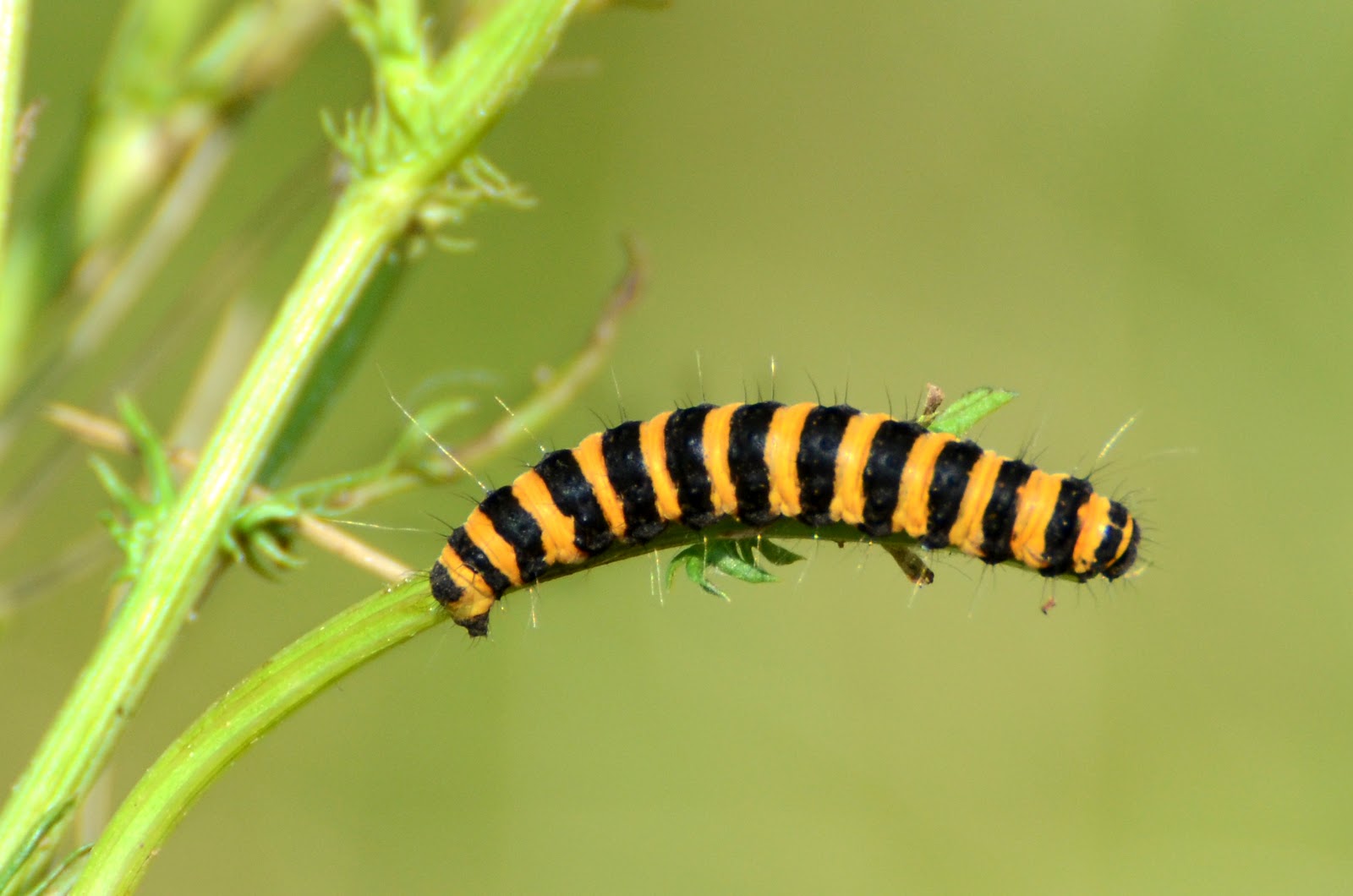
 Cinnabar Moth Caterpillar

This particular individual was found munching away on its chosen food plant – Ragwort – even though the plant was an odd straggler, that escaped the recent cutting of the meadows and was in a pretty exposed position, leaving the caterpillar in full view of anything that fancied a colourful meal. Even more surprising, it was in exactly the same exposed position several days later, which I can only assume means that, this is one very fortunate individual or the warning colour scheme really works.

Or do they just taste bad?

Tuesday, 24 July 2012


Shades On

Warning this post contains sexually explicit material

(That should get the number of hits up)


As you will have gathered from my previous posts, I am very much a beginner when it comes to dragonflies, but as the local birdlife is pretty quiet at this time of year, I have thrown my lot in with the dubious crowd that (seriously) study these wee beasties, in an attempt to broaden my horizons.


Having purchased the bible – Field Guide to Dragonflies and Damselflies of Great Britain and Ireland by Steve Brook (illustrations by Richard Lewington) – I started the process of (mentally) ticking the species I see and recognise and where possible try to get a half decent photograph for future reference, personal gratification and most importantly to try and wind up my expert odo spotting mates at FoHESC.  Unfortunately the latter usually backfires when I proudly display my picture, but have to follow it up with, "I like this picture - but what is it?"


At first it seemed to be going well, Hairy dragonfly – tick, Four-spotted chaser – tick, Emperor – tick, a piece of cake this dragonfly business, then the wheels started to fall off. Clearly the dragonflies had not read the book, had failed to properly adhere to the designated colour scheme or were in fact colour-blind.

 Four-spotted Chaser, very numerous at the moment and real posers

Males and females have different livery, OK, we can cope with that, although it doesn’t help that males often start off pretty darn similar in colour to the ladies. Then a la David Bowie, the boys undergo a number changes in persona, before arriving at the finished article (I assume David is now the finished article). Let me try and demonstrate my confusion, with a few pictures of Ruddy Darters (No, I’m not being disparaging – that’s what Sympetrum sanguineum are called).

The first picture is of a female (I think) but when immature the male looks very similar indeed.


This picture shows the beginning of the colour change in a male but according to the guide he is not yet mature.


Whoa! – immature my foot, big boy’s come of age and doing his funky stuff with Mrs Ruddy D in what I understand is the tandem position (please don’t try this at home).


The pair remained coupled and flew in tandem over the pond surface whilst the female dipped her ovipositor into the water at frequent intervals to lay her eggs, these should hatch into larvae in a few days and emerge as dragonfly in about a year.

Returning to the same spot a couple of hours later I found that the gent was really living up to his name and had become a bright red. Of course I cannot be certain that it was the same dragonfly, although in view of the small numbers of Ruddy Darters in that area I think it may have been. The weather was very warm and sunny – maybe that hastens the colour change – or does the act of mating kick off the change? Hopefully someone will enlighten me.


Male Ruddy Darter (Sympetrum sanguineum) in full colour

It was nice also to observe that I was not the only one looking for flies that afternoon. This Reed Warbler seems to have amassed a pretty impressive collection, which I assume were en route to junior.


If you enjoy any of my photographs or would like to see more, please click on the link to my flickr site at the top right of this page.

Tuesday, 3 July 2012


Murder from the Oriental Empress

Sorry this is going to be a fairly quick post this week as most of my creative juices over the last week or so seem to have been pumped into the FoHESC Blog, and the Save St Peters campaign. Not just creatively dry, but physically drained too, having shed blood sweat and tears on a number of far too physical projects down at the Hanson Centre (in some particularly sultry weather) whilst being transfusion vamped by the rampaging mosquitoes.

I do however have at least one interesting encounter with the pond side battle for survival to recount and hopefully also, a couple of snaps for the ToaBV faithful to enjoy.
On Sunday morning the weather was quite pleasant – sunny if not overly warm – and so I stationed myself near to a pond which had contained quite a few dragonflies the week before, in the hope of a good photo opportunity. If you have seen the FoHESCBlog you may remember the photo of the female Emperor Dragonfly ovipositing, whilst a Four-spotted Chaser hovered nearby, apparently curious, although I’m sure there was a more basic reason involved (food or sex usually covers it).
Anyway the lady in question was definitely for turning and turning ugly at that, as a whirling mass of odonata rattled past my head and alighted in the nearby grass. At first I thought they were mating, but the tiny but unmistakable sound of crunching combined with Mrs Emps jaw grip on the poor unfortunate 4-spots thorax (the head had been bitten off and can be seen on her lower wing) confirmed that dinner was served. Because there was quite a lot of grass around them, it was difficult to get a good, clear, picture but I hope these give a reasonable idea of the scene.
She's only gone an bitten is ead orf
Love Bite?
(At least vampires leave the heads on while they suck the goodness out)

Finally Mrs E got fed up with the paparazzi intruding on her lunch date and with the now diminishing 4-SC firmly clamped in her jaws, relocated beyond my reach. Back on the path however, was a male Black-tailed skimmer – the first I have seen so far this year in the masculine blue livery and very nice too.
Black-tailed skimmer

The knees were now starting to give out with standing for too long in one place, so I walked on round the reserve and was rewarded with these pictures of the Pyramidal Orchid (now a little further in bloom)
The flowers have opened out further since my last picture (see FoHESC Blog)
a Marbled White Butterfly

and A Large Skipper Butterfly.
My what a long proboscis you have
We seem to have Small and Large Skippers on the reserve at the moment (although I have to confess that I am not experienced enough to be totally confident of the differences - I did also think we had Essex Skippers but have since been corrected).

Finally, and with a bit of luck, the Common Terns might hoover up a few of the mosquitoes along with the flies they are catching over the water.

A good morning for all (well apart for one).

for now.

Sunday, 24 June 2012


Paxton – Far from the Pits (But Close to Home)

On Tuesday last, I paid a visit to Paxton Pits, a reserve I was keen to see for a number of reasons, not least of which, was because in many ways, it is similar to our own reserve at HESC.

Paxton Pits can be found about 2 miles north  of St Neots,  just off the A1 and thanks to the new A421, can be reached from MK in not much over 35 minutes.

Like HESC Paxton has evolved out of old gravel workings, but at around 190 acres it is nearly double the size. Paxton is also much younger than HESC, having been officially opened as a Local Nature Reserve (LNR) in 1989.  Parts of the site are still being worked and are currently closed to the public, however, when these workings are phased out over the next ten years, they too will be incorporated into the LNR which will make the site nearly 700 acres in size.

The reserve like HESC consists of a mixture of lakes and meadows, bordered on the east by the river Great Ouse. The lakes and meadows are larger than those at HESC and overall it feels a lot less wooded and more open than the MK site.
Heronry South Lake
Many of the species of birds, mammals, reptiles  and insects are also similar to those we get at the Hanson Centre, although Paxton has the attraction of Nightingales for the birders (Turtle Dove were also present when I visited) and for the Dragonfly enthusiast the site holds the rare Norfolk Hawker.

At the time of my visit the lakes held good numbers of Common Tern, interspersed with B H Gulls and a fair few Cormorants. There were also quite a few rafts of Tufted Duck on the water. The Kingfisher hide failed to live up to it’s name but I was reliable informed by the locals that not only Kingfisher but also Otter can be regularly spotted from this viewing point.
Common Tern Whizzing Past The Kingfisher Hide
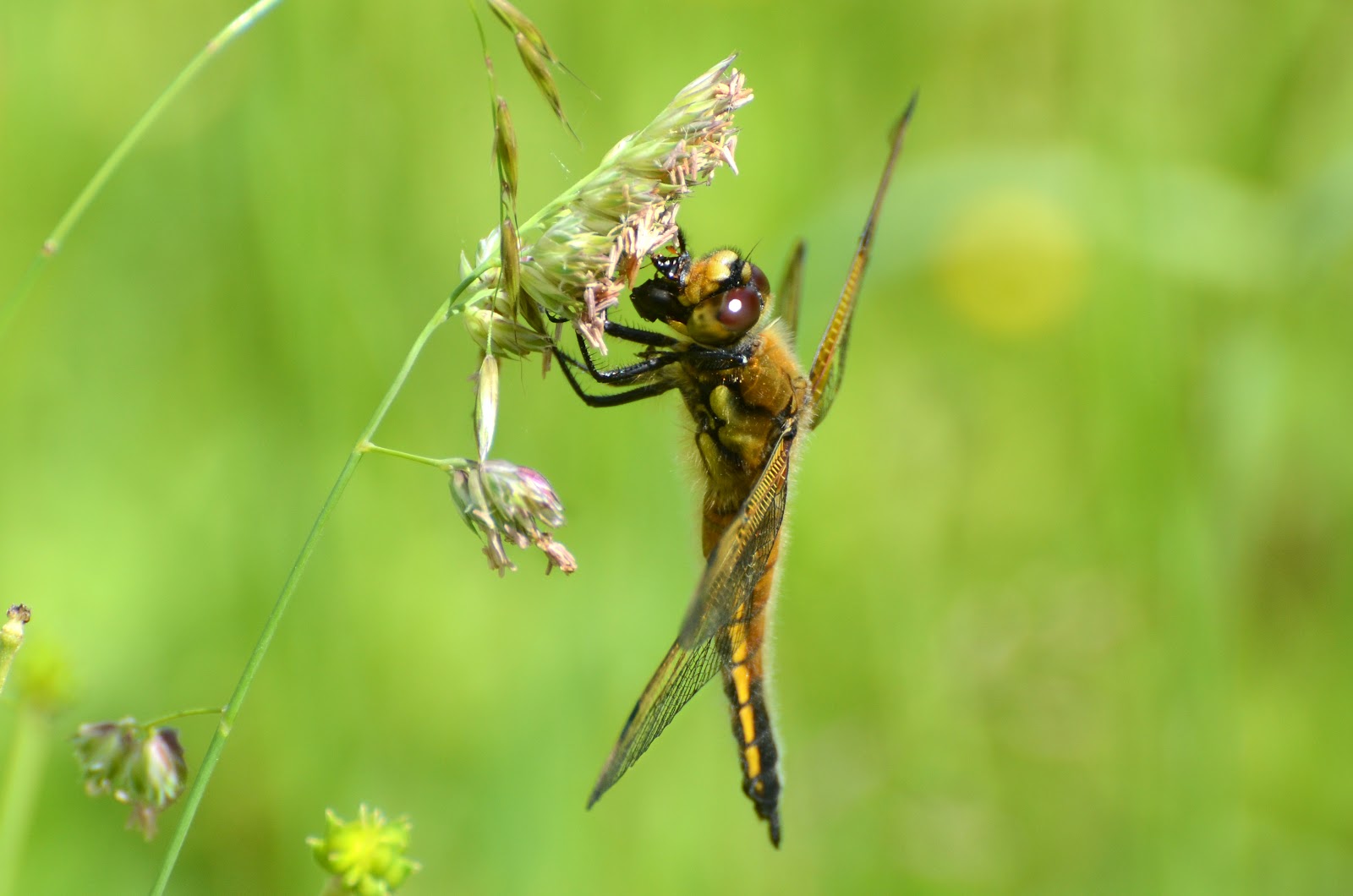
After spending some time exploring the lakes and following the Heron Trail, which is about 2 miles long, I back-tracked to the Visitor Centre, to explore the Meadows Trail (1.5 miles), where I was told my best chances of encountering the elusive Norfolk Hawker lay. Although the meadows did hold quite a few Dragonflies, I was unable to identify the invader from the east. During my search I did manage a close encounter with a Four-spotted Chaser munching a large black bug and then came across a Common Spotted Orchid growing by the side of the pathway.
Common Spotted Orchid
By this time I was ready for a sit down and a cold drink and so I returned to the Visitors Centre and enjoyed a long chat with Jim Stevenson the full time Ranger and two of the volunteer wardens from the friends group. I was particularly interested to learn how the reserve is run and managed.

They explained that Huntingdonshire District Council’s Countryside Services is responsible for the Reserve, whilst the Ranger manages the Reserve according to the Management Agreement under the terms of the Local Nature Reserve (LNR) designation.The Ranger is advised by a Management Group, which includes local experts, Natural England, landowners within the LNR, The Friends of Paxton Pits Nature Reserve, the Volunteer Warden Coordinator and the two Aggregate Companies.

Much of the funding for projects and help in maintaining the site is provided by the Friends of Paxton Pits Nature Reserve which has over 2000 members. I was amazed to hear that the reserve receives around 120,000 visitors a year, although it should be remembered that in many ways it is a public park, with free entry and allows dog walking and fishing on some of the smaller lakes.

The FoPPNR volunteer wardens and rangers staff the Visitors Centre and provide information to visitors as well as selling light refreshments, a few books, maps, bird seed and feeders etc.
Four-spotted Chaser taking afternoon tea
(I am told the Scarce Chaser is more common on this reserve!)
I was made extremely welcome by the people at Paxton and will certainly return soon. For me the visit was very inspirational and I came away thinking that whilst not all that they do at PP would be right for HESC, we could certainly learn from many of their initiatives.

Monday, 18 June 2012


And Breathe

Ouch, something has just pricked my conscience.

Having just watched and enjoyed,  the formerly berated Mr C Packham do an excellent job of presenting, what promises to be a top drawer Nature programme,  Secrets of Our Living Planet , I felt obliged, in no Nalbandian way, to come clean.

Despite the slightly naff title, the content was fascinating and the photography, as with most wildlife docu’s these days, was superb. But, more to the point, so was the narrative.

Minus the Fop with the Mop and Lizzie Dripping and free to make intelligent and informative commentary, combined with  the passion and enthusiasm we know he has for the subject, Mr P was in his element.

Such a shame then, that Springwatch tried so badly to be a cross between Topgear and Animal Magic and ended up being just Tragic.

I know the format is vastly different, but still can’t help thinking that there is huge scope to reveal homespun nature as both interesting and entertaining, without becoming infantile and ultimately insulting to the audience. Particularly, when there is talent such as Chris Packham available.

Friday, 15 June 2012


Smother Nature

As the Springwatch season grinds to a halt for another year (or at least until Summerwatch, Autumnwatch, Winterwatch, AugustBankHolidaywatch et al) that hoary old chestnut (no not Bill Oddie) raises its head again.  Have the BBC producers been guilty of over indulging in anthropomorphism, as they take us through the tortuous agonies of watching the life and death struggle of those poor fated creatures present the show?

 Yes I’m talking about Chrissie (Iknowalot  Butoverbearinglysmug), Martiny (Iknowabit Butlovemyhairmorethanlife) and Michaelary (Iknowhowtosmile Buthopekatiestaysaway).

We all know that to try and pretend they are just like real humans is ridiculous, the constant preening needed to keep their public images glossy and self importance glistening, is far greater than you are likely to find amongst  homo sapiens.  If they stray too far from the camera lens, they fear that the cold of public indifference will cause them to shrivel and die.


Let me do T'Auking


And so, irrespective of the brilliant wildlife action some unseen hero has captured and no matter how interesting the subject matter could be, they will witter on and on to camera, in an attempt to turn a Puffin nesting into Peyton Place or a Woodpecker feeding into Silence of the Lambs.


Hannibal Lecter - I think not


To get too sentimental about their chances of survival in TV Land is also a mistake. Only one in three will achieve maturity and or respect – Attenborough as it is known by followers of the species.

Remember we have already seen the demise of little Billy, who was sadly put down after becoming over agitated with the habitat he was forced to live in (and garbage he was being asked to present). Simony (Photographicus Splendicus) would seem to have found richer pastures to graze and what of the sainted Katie (Imsolovely Youdontcarewhatisay)?  Will she ever return to the Springwatch ecobubble, or will the biodiversity of general presenter land hold her forever?

Photographicus Splendicus (Very much in his environment at sea off Unst)


But beware, because new and possibly evasive species are starting to mark their territories in front of the camera and have quickly learnt how to mimic the attraction cries of the creatures they hope to replace. The silver tongued Iolo, which originates from among  the caves and forested mountains of Powys, can now be heard to reproduce a-m-a-z-i-n-g and  i-n-c-r-e-d-i-b-l-e so realistically that it is indiscernible from the real thing.

Young pretenders like the Charlie (also Photographicus Splendicus) may have learnt how to maximize  opportunities and take prime position by pairing with Producicus Wildlifedocumentary. The Charlie seems to have evolved with a greater covering of head hair than the former camera pointer, in order to be protected from the studio lights. Is this an indication of his intention to move in from the cold?

Whatever happens, don’t worry, if one or two should fail to survive, others will come in their place, prime-time nature programming has a way of ensuring its own survival by using a system called “talkdown”, sometimes also known as “target the lowest common denominator”.

I am told by the experts that study the Springwatch phenomena, that if you watch very, very closely sometimes you can catch glimpses of birds and other animals, r-e-m-a-r-k-a-b-l-e.

Saturday, 2 June 2012


Neat Rye

Last Wednesday I made a trip down to the RSPB Nature Reserve at Rye Meads near Hoddesdon, in Hertfordshire. An area I have the misfortune to know reasonably well as a result of working between 1986 and 2002 for a company whose head office was based there.

I must say straight away, that this was by far and away the most pleasant visit I have made to the area. Rye Meads is an excellent Reserve comprising of a variety of wetland habitats, including lagoons, pools, reed beds and scrapes, plus meadows and a section of the River Lee. Hides (ten) and observation platforms are positioned along 1.3 km of paths overlooking the various habitats. The reserve supports birds such as wildfowl, waders and bitterns, as well as many other kinds of wildlife including water vole and otter.


River Lee at Rye Meads


I had been recommended the site by a photographer who had advised me it was one of the best places in the country to see and photograph Kingfishers. I was also keen to see the artificial nesting bank which had been built there and which I am told, has successfully been used by breeding pairs of Alcedo atthis for many years. I have a particular interest in this subject, as it is my hope that our Friends Group at HESC may be able to build a similar nesting site in the near future, so that we too can enjoy regular and closer views of these brilliant little birds.


HESC Kingfisher


On arrival I was greeted at the visitor centre by RSPB volunteers, who confirmed that as a RSPB member, car parking was free (£2.00 otherwise) and that there was no charge for entry to the site. They gave me instructions on finding the Kingfisher Hide and I was pleased to learn that the designer of the nesting site was also around and would be happy to discuss the construction process with me.

Ten minutes later, after a pleasant walk, I settled down in the Kingfisher hide to await proceedings.


 The "Layer Cake" Nest Site at Rye Meads


Soon the flash of azure and orange heralded the arrival of the male Kingfisher who perched on a post in front of the nest site. Unfortunately, this revealed another fact that was to unfold, throughout the next three hours. Much to my and the other happy snappers dismay, the post in question was a favourite spot for both the male and female bird, it was also well out of comfortable range for any lens with  a focal length of less than 500mm.

There is a blue thing far away (Rye Meads Male Kingfisher)


There were several other possible perching points around the pool, many much closer to the hide and the anticipatory lenses, but, despite many prayers, pleas and oaths being muttered by the hopeful (desperate) throng, the birds remained just out of effective range to all of us, except those, lucky enough, to be armed with big bertha glass.

During my wait, I was however, able to meet with Keith Bedford who had designed and built the artificial nest site and was able to learn exactly how the layer cake of concrete and sand was constructed and to take notes for hopefully future use at HESC.

The timing of my visit could have been better, as the first brood of young “Alcedos” had fledged about five days earlier and as is the way with Kingfishers, had departed the nest area soon after to find their own way in the world. Ma and Pa meanwhile had started on the second brood which meant the female spent quite a lot of time in the nest hole, whilst Dad perched nearby or went off scouting for fish. It will be another six weeks or so before the next brood fledge and so I will be monitoring the Rye Mead blog in order to plan another visit, when hopefully there will be more (and closer) activity around the pool.


Little Grebe under the Draper Hide


Having spent so long in one hide, I had not left much time to visit the rest of the reserve, but was able to call in at three more hides on the way back to the car. In particular I enjoyed the Draper hide, where I was able to see waterfowl, terns and a pair of Little Ringed Plover, sharing spits and islands of land, within easy viewing range of the hide, whilst a Little Grebe fed under my feet. I also encountered a fox walking across the path in front of me with a chicken in its mouth. I was later advised this was a local character by the name of Elsie.


Little Ringed Plover


I thoroughly enjoyed my visit to Rye Meads, which is about an hour and ten minutes drive from Milton Keynes where I live and intend to visit again before the summer is out. Who knows, maybe I can justify the expense of a new lens to get the best out of the return trip.